
Beyond the Prompt: Building with GenMedia


I had a great time facilitating and learning at Google Cloud Labs London. I also completed the hands-on lab, Building with GenMedia for Developers, end to end myself. Working through the experience made the practical questions much clearer: how does an input become a useful generated asset, and what does it take to make that workflow work as an application?
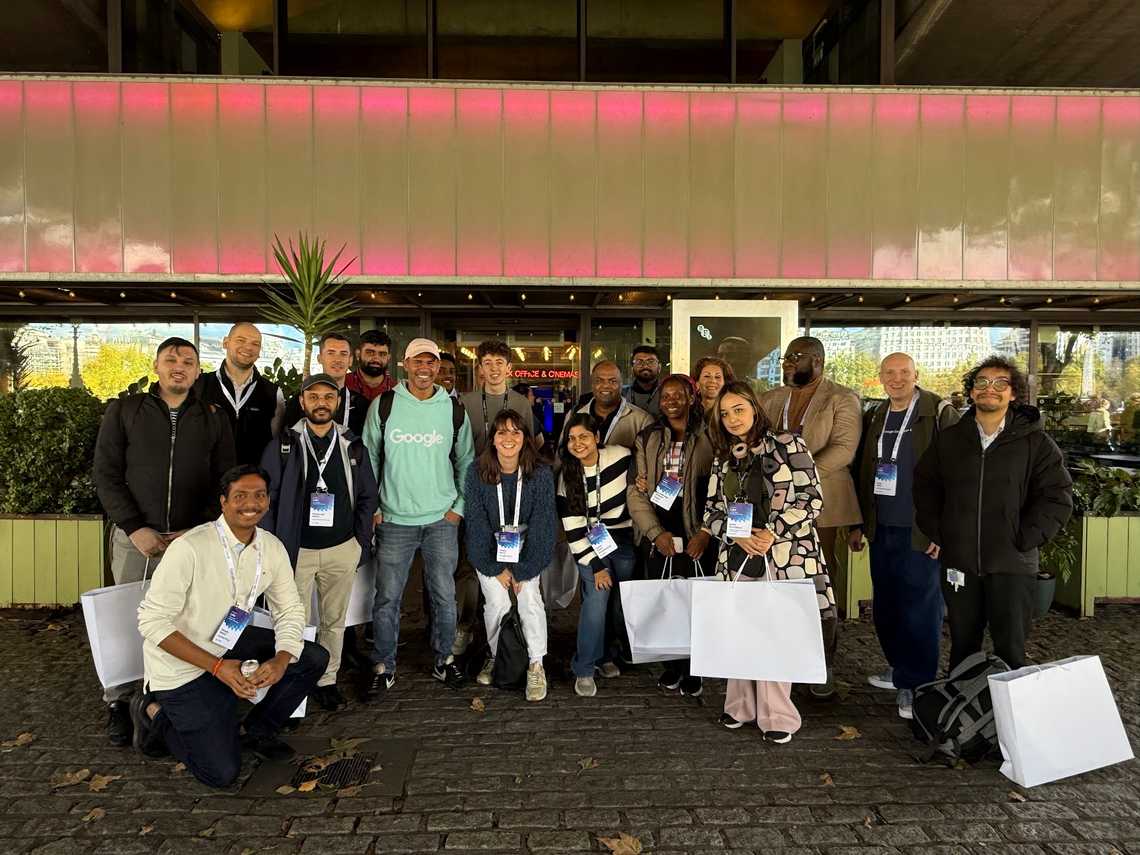
The people behind the learning: friends and the developer community. Original event photograph, IMG_3316.jpg, reproduced without generative edits.
Building beyond a single prompt
The Formula E setting gave the lab a concrete creative goal. The linked Google codelab describes a kiosk experience where a person supplies a photo, chooses a racing scenario and receives generated media. Its documented workflow connects prompt preparation, image generation and asynchronous video generation with an application deployed on Cloud Run.
My completed learning activity was the GenMedia lab. The linked tutorial is a living document; the model names and code on that page can change. I am describing the workflow here rather than claiming that every detail of its current version was part of the event session.
What stayed with me was the move from asking a model for an output to thinking about the whole experience. The input, the scenario, the generated image and the wait for a video are connected product decisions. A compelling result needs a useful journey around it.
AI-generated supporting illustration. This is conceptual artwork, not an event photograph, application screenshot or lab output.
The workflow, and where ADK could fit next
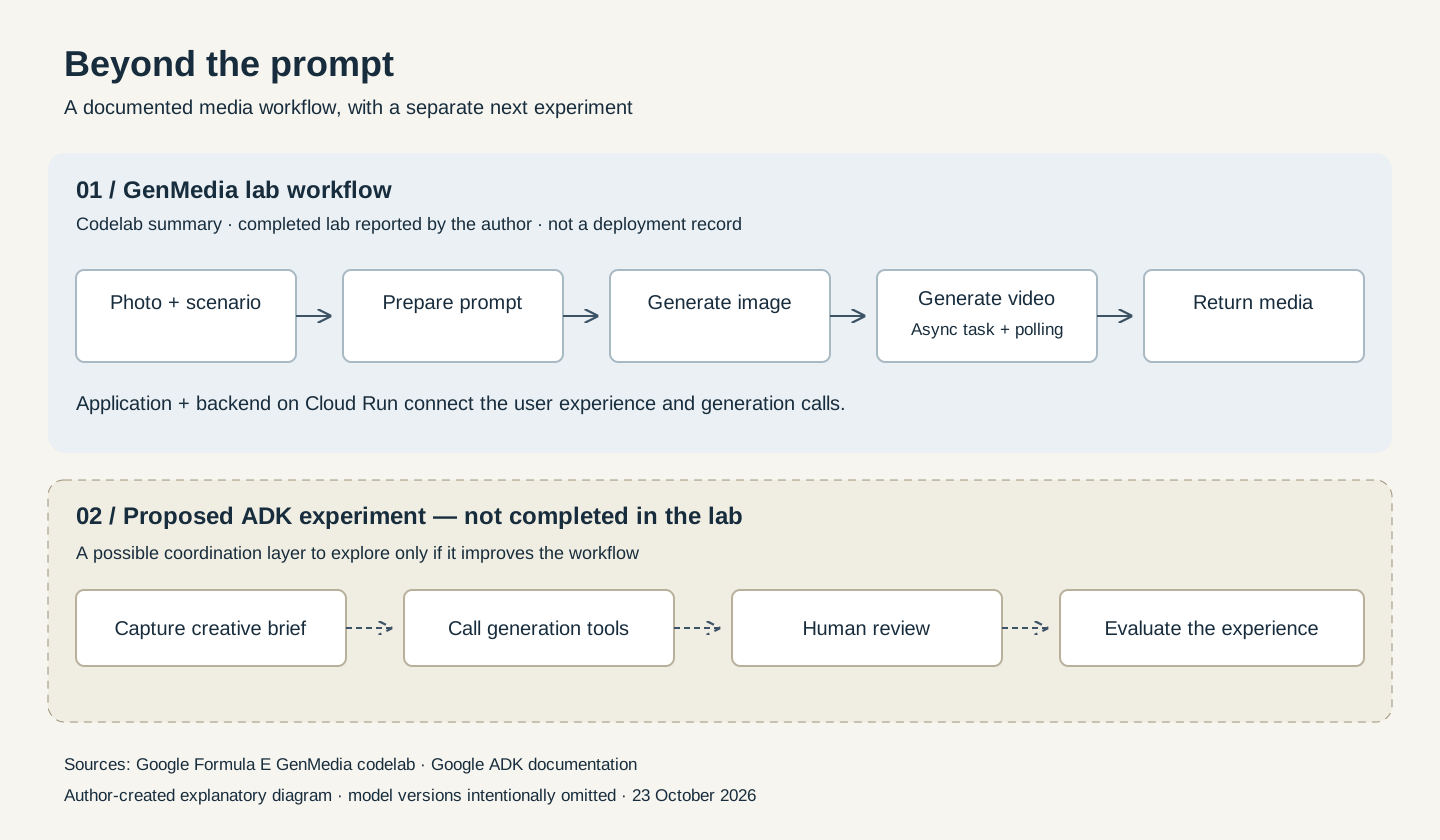
Author-created architecture summary based on the linked codelab and Google ADK documentation. The upper lane summarises the documented lab; the lower lane is proposed future work. It is not a deployment record or evidence that I built an ADK agent.
The lab workflow is enough to explore a complete media experience: accept input, prepare the creative instruction, generate media and return the result through an application. Video generation also raises a practical question about how the interface communicates a task that takes time to complete.
My next experiment would be to explore Google’s Agent Development Kit (ADK). Its documentation covers agents, tools, workflow coordination, runtime state and evaluation. Those capabilities suggest a way to organise a more involved creative process, but adding a framework should solve a real coordination problem.
For example, I would try a small workflow that captures a creative brief, calls a generation tool and presents the result for human review. I would then evaluate whether the extra orchestration improves the experience. That ADK extension is a proposal, not work I completed in this GenMedia lab. A sequence of model calls alone is not evidence that an agentic system was built.
Creative prompting is something to practise
I also went through the AI Video Gen Challenge write-up. It gave me another reason to keep practising how I describe an intended scene and judge the result. I am recording that as additional learning, not claiming a competition result or a separate deployed application.
For my own next round, I want to make the creative brief more explicit: what should happen, what should remain consistent and what would make the result unsuitable? Keeping the brief alongside the output would make review more useful than relying on memory or simply choosing the most impressive-looking clip.
What this says to me about the state of AI
My takeaway is that the useful work increasingly sits around the generation step. The models make a creative experiment possible; the application still needs clear inputs, understandable progress, recoverable failures and a way for a person to judge the output.
That is a personal reflection from the learning experience, not a benchmark or a claim that a workshop prototype is production-ready. Before using a similar experience with real users, I would want to test output quality, latency and cost, and decide how uploaded photos and generated assets should be handled.
The community was just as valuable as the technical material. Facilitating, trying the lab myself and learning alongside friends made this a memorable event. My next step is to turn the learning into a small, reviewable experiment, with a clear distinction between what I have completed and what I plan to build.
I have also shared an event reflection on LinkedIn.
Sources and attribution
- Google Cloud Labs London — Formula E event page. Official event link; the page requires JavaScript and its agenda could not be independently extracted during this review.
- Formula E GenMedia codelab. Technical source for the kiosk workflow; current documentation may differ from the session version.
- Google Agent Development Kit documentation. Background for the proposed ADK experiment, not evidence of completed ADK work.
- AI Video Gen Challenge. Additional learning material I went through.
Event participation and lab completion are my own account. The community photo is my original supplied event image. The supporting illustration is AI-generated, and the architecture diagram is an explanatory summary.

Related Posts

Quick Links
Explore topics